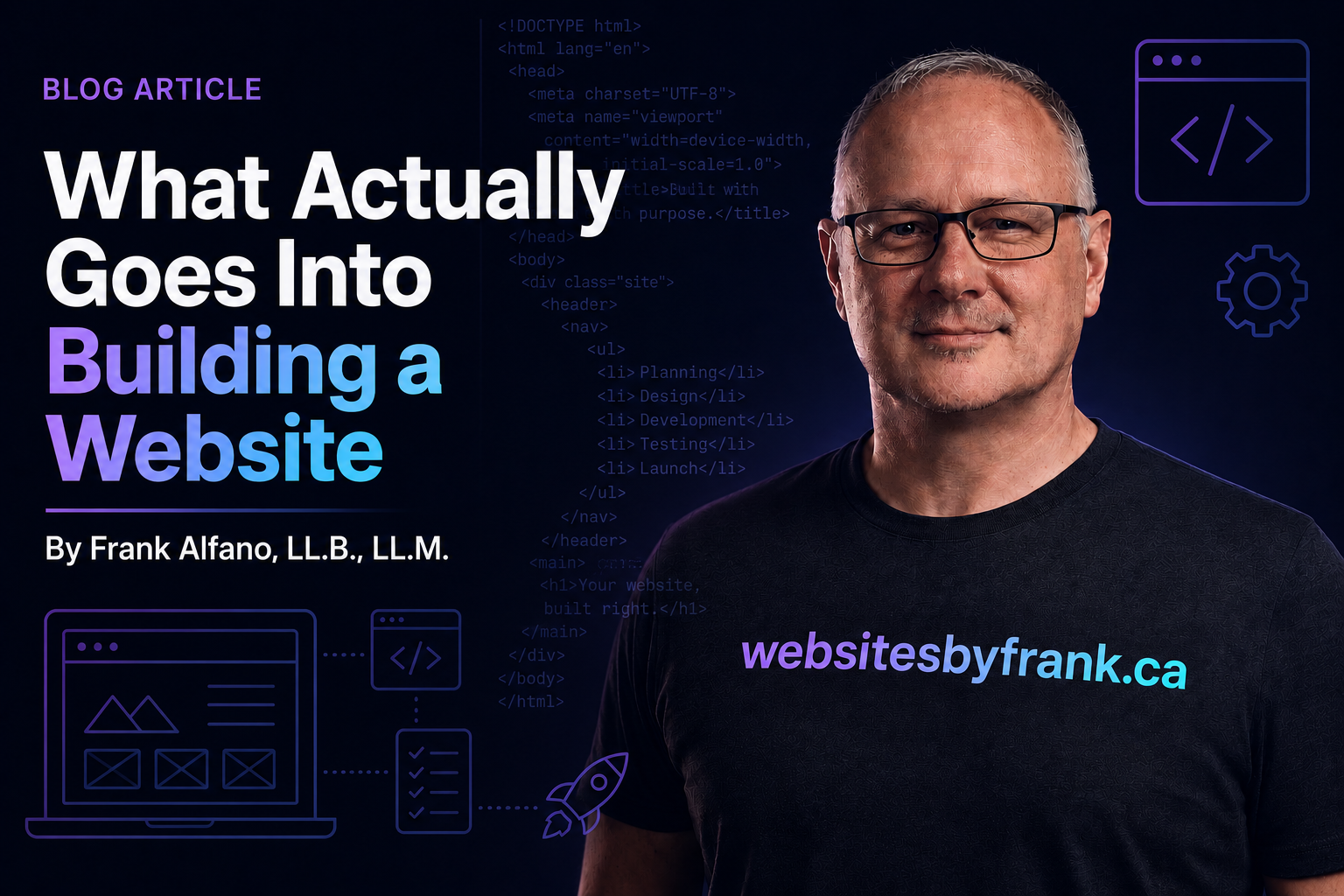
What Regulated Professionals Need in a Web Developer
Most web developers build what looks good. Regulated professionals, lawyers, doctors, realtors, mortgage agents, need a site their regulator can live with. Here's what should be in the build, and what usually isn't.

What Regulated Professionals Need in a Web Developer
By Frank Alfano, LL.B., LL.M.
If you are a lawyer, paralegal, doctor, real estate agent, or mortgage agent in Canada, your website is not just marketing. It is a regulated communication. The same regulator that licenses you also has rules about what you can say on it, how you can say it, and what disclosures need to be on the page before you say anything at all.
Most web developers don't know that. They build what looks good. They hand you a polished homepage and a contact form and consider the job done. Six months later you get a letter from your regulator about something on your About page, a complaint about a missing privacy disclosure, or you find that a competitor's near-identical content has tanked your Google ranking. Now you are paying a lawyer to fix a website problem.
That gap is what I built my practice around.
The problem most web developers don't see
A typical developer pipeline looks like this: choose a template, drop in photos, write marketing copy, push live. The technology is fine. The design might even be excellent. What's missing is the layer underneath, the part regulated professionals actually need.
Lawyers and paralegals fall under Law Society of Ontario advertising rules, with sister rules in every other province through their respective law societies. Physicians answer to the College of Physicians and Surgeons in their province. Real estate professionals to RECO in Ontario, and to the equivalent provincial regulator elsewhere. Mortgage agents to FSRA in Ontario, and to the corresponding superintendent or commission in their province. Each of these regulators has something to say about how you advertise yourself and what your public-facing materials must disclose.
A web developer who has never read those rules cannot build to them. They don't know what you can't say. They don't know which disclaimers belong on which pages. They certainly don't know what your regulator considers a "testimonial" versus a permitted client comment.
Compliance is the part that gets skipped
At a minimum, a Canadian professional's website needs:
- A terms of service page that actually fits the services you offer, not boilerplate from a template generator
- A privacy policy that reflects how you really collect, store, and use client data, and that complies with PIPEDA federally plus any provincial privacy legislation that applies (Quebec's Law 25, BC's PIPA, Alberta's PIPA)
- Regulator-required disclosures specific to your profession, firm name, licence number, insurance status, jurisdictional limits, and anything else your regulator demands
- Accessibility that meets the AODA standard in Ontario, with equivalent legislation in Manitoba, Nova Scotia, BC, and a federal Accessible Canada Act layer for federally regulated entities, all of which point at WCAG 2.0 AA as the practical bar
- Honest claims , no language that overstates your expertise, no comparative claims your regulator forbids, no reviews displayed in a way that breaches the rules
Most off-the-shelf templates ship with none of this. The free privacy policy generators floating around the internet were not written for your regulator, your province, or your liability profile.
Why I work differently
I am a web developer. I was also a licensed Ontario paralegal for over 33 years. I hold an LL.B. from the University of London and an LL.M. from Osgoode Hall. I operate Oversight Intelligence, an Ontario private investigation agency licensed under the PSISA, which makes me a regulated professional building websites for other regulated professionals.
That background changes how I build. Compliance gets baked in at the planning stage, not bolted on at the end. When I draft your privacy policy, I draft it against the law that actually applies to your practice. When I write your service pages, I write them inside the lines your regulator has drawn. When I structure a testimonials section, I structure it the way your regulator allows, or I tell you why you shouldn't have one at all.
I also do something most web developers can't: when there is an online reputational issue, a misleading review, a defamatory post, an old article that won't die, Oversight Intelligence can investigate it, identify the source, and pursue it through the proper channels. That capability sits inside the same engagement.
Why custom, not WordPress, Wix, or Squarespace
WordPress runs roughly 40 percent of the web, which is also the reason it gets attacked constantly. Plugin vulnerabilities, abandoned themes, login-page brute forcing, supply-chain compromises through nulled plugins; the security overhead on a WordPress site for a professional is real, and most "WordPress developers" leave it for the client to manage. A breach on a law firm's site is not an inconvenience. It is a privilege problem. A breach on a medical practice site is a privacy-commissioner problem.
Wix and Squarespace ship a usable site quickly. They also ship a site that looks like every other Wix or Squarespace site. Clients of professionals, especially clients in distress, which describes most of the people hiring lawyers, PIs, doctors for second opinions, or mortgage agents in difficult financing situations, read those visual signals. A drag-and-drop site reads as small, generic, and a little amateur. That is not the impression you want while someone decides whether to trust you with their case, their health, or their money.
I build custom Django sites. They are fast, secure, hosted on dedicated infrastructure, and they look like your firm rather than a template. The HTML is clean, which Google rewards in rankings. The site is yours, the database is yours, and you don't pay a monthly subscription to a platform that owns your front door.
Original content beats spun content every time
A common move in cheap professional-website packages is a shared content library that gets recycled across every client in that vertical, with a thesaurus algorithm swapping words to avoid exact-match duplication. It looks like content. Google reads it as duplicate or near-duplicate. The penalty is not always a manual action. More often the page just never ranks, or your domain gets quietly suppressed below competitors who paid for original work.
Every page I write for a client is written from scratch for that client, against a keyword plan that targets the searches their actual prospects are running. No spinning, no swapping, no copy-paste between firms.
A site that ranks needs feeding
There is no version of search engine optimization where you build a site, flip the switch, and rank first the next morning. Anyone selling that is selling a story.
Ranking comes from consistent, useful, indexed content over time. For a professional, that means a real blog program, posts that answer the questions your prospects type into Google, written with keywords that actually convert, published on a schedule, internally linked, and pushed to your social channels so they get seen. The maintenance is at least as important as the launch.
I run that program for clients who want it. I research the keywords, draft the articles, queue them on a publishing calendar, and push each post out to Facebook, LinkedIn, and X automatically when it goes live, through a dashboard your staff can manage.
The full list of what I do for regulated professionals
- Custom Django websites , no WordPress, no Wix, no Squarespace
- Regulator compliance audit at the planning stage, terms, privacy, advertising rules, accessibility
- Original SEO content, written for your actual keywords, never spun or recycled
- Monthly blog program with researched topics, full drafts, indexing, and internal linking
- Blog-to-social automation so every post is pushed to Facebook, LinkedIn, and X
- Staff dashboard or client portal so you and your team can manage projects, posts, leads, files, and invoices without waiting on me
- OSINT and online reputation investigation through Oversight Intelligence
- Reputational issue management , review responses, takedown requests, search-result suppression where lawful
- Domain email like
info@yourfirm.caso you stop sending client correspondence from a Gmail address - Dedicated VPS hosting, not shared hosting, with security patching and uptime monitoring built in
- GA4 analytics and a monthly performance report so you can see what is actually working
If this sounds like what you have been missing
I take on a small number of projects at a time so each one gets the attention regulated work needs. If your current site looks fine but you are not sure it would survive a regulator complaint, or you are starting from scratch and want it done properly the first time, send a message through the contact form at frankalfano.ca and I'll get back to you.
The website is the easy part. Building one that ranks, holds up to your regulator, and represents you the way a serious professional should be represented; that is the work.
Frank Alfano, LL.B., LL.M.
Want these in your inbox?
Roughly monthly. Unsubscribe any time.